Benjamin Renoux
Historical fortepiano maker and piano technician. Workshop-centred work focused on sound, between historical making and contemporary development.
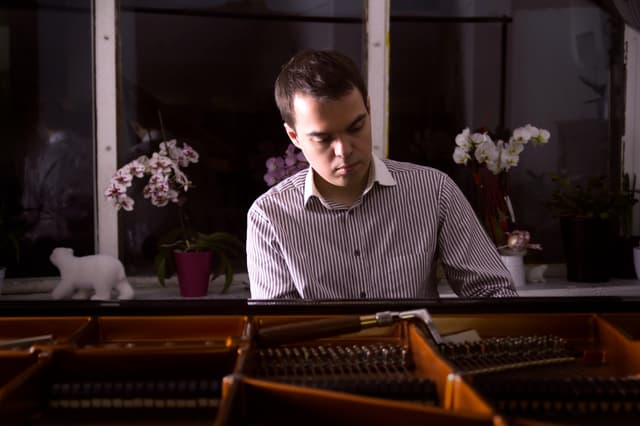
A perspective forged off the beaten path
Benjamin Renoux did not come to instrument making through the usual channels. Before the workshop, there was accounting, then a pivot to the ITEMM in Le Mans — training as a modern piano technician. It was there that working with actions and sonorities took shape, and the direction became clear: build instruments.
This detour is not a deviation — it is what structures his practice. A technical eye, a trained ear, and a freedom from academic convention that allows him to approach each instrument without constraining precedent.
From conservatoire to workbench — a continuous formation
- Age 11First piano lessons
- ChartresConservatoire — piano, harpsichord, theory, composition, choir
- ITEMM · Le MansModern piano technician training
- 2007 – 2014Beginning of fortepiano making and construction of the first instrument
- 2014First fortepiano after Anton Walter (1795–1800) — album recorded on this instrument
- TodayWorkshop in Guebwiller, Alsace — active in France, Belgium and Switzerland
Four lines of work
Fortepiano making
Construction of historical instruments based on Viennese models of the 18th and 19th centuries, particularly Anton Walter. Each instrument is designed for professional musical practice and built to last.
Restoration of antique pianos
Eighty restorations carried out on instruments from the 19th and early 20th centuries. The work aims to restore the original gesture: structure, action, sonority. No transformation, no compromise on historical integrity.
Instrument modernisation
Taking an instrument from the late 19th or early 20th century and finding the best balance between what must be restored and what must be modernised — so that neither undermines the other.
Modern concert piano
A long-term project, developed in the workshop: designing a contemporary concert piano built on principles drawn from historical instrument making. In development.
Instruments in active use
- Conservatoire de Strasbourg
- Conservatoire de Poitiers
- Conservatoire de Neuchâtel (Switzerland)
- Opéra National de Lorraine
- Grand Théâtre de Luxembourg
- Opéra Royal de Wallonie — Liège
- Opéra de Poitiers
A space for making and active research
The Guebwiller workshop, acquired about ten years ago, is in permanent development. It is the central place of practice: making, restoration, action regulation, sonic experimentation. Neither museum nor showroom — a place where instruments are born and questions remain open.
Working for the sound.